
By Peter Lindblad
Blue October is bound and determined to be Foiled again.
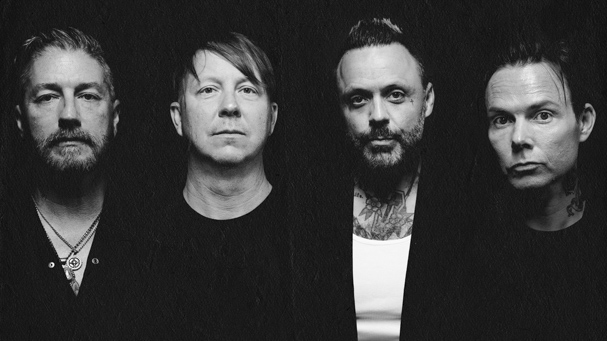
It’s taken 20 years, but the dark and heavy, soul-baring alternative-rock monster is finally doing a proper tour behind its cathartic breakout album that includes an Oct. 28 date at Milwaukee’s Pabst Theater.
Bassist Matt Noveskey explains what happened in 2006 that resulted in limited road support for a record that changed everything for Blue October.
“So, I mean, we did a bit, but not like we should have,” said Noveskey.
When Foiled was first released, Blue October was on a little radio promotional tour, just the band and its manager, according to Noveskey.
Then, the uncomfortably honest, emotionally charged single “Hate Me” took off, and “every day our manager was like getting more and more excited … like, ‘Guys, the song is actually doing something,’” said Noveskey.
As “Hate Me” was catching on, Noveskey said crowds at Blue October shows were “doubling and tripling in size.”
However, misfortune befell Blue October just as momentum was building, as frontman Justin Furstenfeld suffered a serious leg injury.
“Our singer, poor guy, we decided to celebrate one night or one afternoon, I should say, in Tampa and run the bases at this baseball stadium that we played at,” said Noveskey. “And he just twisted his leg just wrong and went down and tore his like ACL, MCL and PCL I want to say, and it just completely put him out of commission.”
Bummed out, as Noveskey recalled, “That was a long ride home,” Blue October was forced to take a break. And then, just after Furstenfeld started feeling healthy again, he was reinjured.
“And so, we were like, ‘Okay, well, let’s go back out when we can,’” said Noveskey. “But you know how it is, man, these short attention spans. So, by the time the second, third song comes around and is doing what [it’s] doing, it’s like we’re just kind of playing catch up at that point, trying to get out in front of people.”
There were shows where Furstenfeld performed with Blue October while seated in a chair. They were even able to open for The Rolling Stones in Boise, Idaho.
“And he soldiered through it and did it,” said Noveskey. “So, we at least had some highlights that we were able to go out and do, but a full tour was just off the table at that point.”
Understandably, Noveskey and company are excited for the upcoming tour, with the first-ever vinyl release and special 20th anniversary edition of Foiled also part of the celebration.
“It’s crazy, honestly, and if you told us 20 years ago that this would be happening, we would all be like, ‘What? Like, what are you talking about?’” said Noveskey. “But honestly, I feel like we’re all so grateful, because 20 years later, we’re healthier and happier and more creative than we’ve ever been. But to be able to instead of being like, ‘Hey, new music, new music, new music’ – like we’ve been doing for the last 20 years – we can kind of stop and put a pause on that and go, ‘Hey, let’s celebrate something that we’ve done.’”
‘Hey, let’s celebrate something that we’ve done.’”
Highlighting the LP that made such an impact on them and others, while getting a chance to do things they never got to do back then, Blue October is feeling nostalgic. The band hopes others are, as well, as they look to “spend some time with some people that maybe haven’t come out and seen us in a while, you know?” said Noveskey.
Anticipation for Blue October’s “20th Anniversary World Tour” of Foiled is undeniably feverish.
“For whatever reason, people really seem to gravitate to this idea. And there are a ton of people out there that are super excited to come out to the shows. So, now we just gotta deliver it. We just gotta play it like we’re not old people,” laughed Noveskey.
Established in 1995, Blue October originated in Houston, Texas, and was discovered by Kid Rock manager Michael Rand while playing in a café, linking up with Universal Music Group.
They released the album The Answers in 1998, and then signed with Universal Records in 1999, only to be dropped a year later after uncorking their sophomore effort, Consent to Treatment.
A third album, History for Sale, emerged after Blue October signed with Brando Records in 2002, with the single “Calling You” getting radio play both in Dallas and nationally. There was a feeding frenzy for Blue October among major labels, with Universal Republic Records winning out over Atlantic and Columbia. Universal Republic re-released History for Sale, but it was “Hate Me,” performed on “Jimmy Kimmel Live!” by Blue October, that caught fire, shooting up to No. 2 on the Billboard Modern Rock Tracks chart.
“There was no opportunity to kind of stop and smell the roses, you know?” said Noveskey. “And if there was, it was the weeds at that point, because you’re going, ‘Wait, what? What’s going on?’”
During the making of Foiled, Noveskey believed in what they were doing.
“The album itself, I remember when we were making it, it felt special,” said Noveskey. “It did. It was like, man, something is going on here. Sometimes you just know in your gut things are falling into place. And it wasn’t easy. We had to re-record some songs. It wasn’t like it all just magically fell into place. It was a lot of elbow grease. It was a lot of work. But as we were getting the results, it was like, ‘Man, like, am I crazy? Because I feel like this is the best stuff we’ve ever done, you know?’”
Interestingly, though, he didn’t feel that “Hate Me” was going to set the world on fire.
“Not on my radar. Like, I didn’t see that as a single at all. I was like, ‘Well, really?’” said Noveskey. “That’s a very depressing seven-minute song. But it wound up being the catalyst to everything. It wound up, just, I guess, right place, right time. And a lot of people really gravitated to the message, and it just kind of blew up and that was it. After that, it was off to the races.”
Recently, Blue October visited Cabo San Lucas, Mexico, for an event that allowed them to meet one-on-one with fans. That’s where they found out just how much Foiled and “Hate Me” still mean to people.
“We spend a lot of time, like all day, just hanging out with people in this beautiful place and the sun and the pool and all this,” said Noveskey. “And then we play some shows, and it’s a really special time and it’s a chance for us to get to know people. So it’s a chance to sit, and [say,] ‘Hey, here I’m the artist, here’s my story and here’s my interpretation.’ You get to hear what it means to them and what their interpretations of certain songs are. And one thing that I heard a lot when we were down there from a lot of different people was that album in particular … and they were like, ‘Man, I have such great memories associated with that record,’ but the thing that I heard a lot was that song ‘Hate Me’ and that album as a whole came at a time when I needed it.”
Novesky remembers feeling the same way when he first heard records by Jane’s Addiction and The Cocteau Twins and how they made him feel less isolated.
“In certain songs, really, I was like, ‘Whoa, this is the soundtrack to my day in my life,’” said Noveskey. “So, I think that’s the biggest thing is that record, I hear a lot of people’s stories about it, but I hear a lot of people come back and say, ‘There was something about that song, because there was nothing else on the radio like it at the time, and I needed just honest, something really genuine, and something that’s talked about things that most people weren’t necessarily talking about on the radio. So, I think it just it really touched people that needed to hear what it was about and that’s a good thing.”
By turns brooding and explosive, “Hate Me” delved deeply into addiction and depression. It was written by Justin Furstenfeld and an actual call from his worried mother introduces the song.
For his part, Noveskey recalls seeing songs like Gnarls Barkley’s “Crazy” and Outkast’s “Hey Ya” on the charts and realizing how different “Hate Me” was.
“It was like, man, there’s all these really cool, fun, almost kind of party songs going on, and then there’s this,” said Noveskey. “I just felt like it was kind of in a unique position to kind of occupy a space that wasn’t being occupied by anybody else.”
“I just felt like it was kind of in a unique position to kind of occupy a space that wasn’t being occupied by anybody else.”
As a bass player, Noveskey said his parts in the song were “pretty straightforward” and “knocked them out in a day.” They were at a Los Angeles studio wrapping things up, and Noveskey said he went to take a break.
“I went out right outside the door, and Paul Stanley was sitting there on the phone,” said Noveskey. “I was like, ‘This is so weird.’ And then I go to the bathroom and Randy Jackson’s walking out of the bathroom. And then, and I’m not even kidding, later that day, I finished up and went outside, and Melissa Etheridge walked by and said, ‘Hi.’ And I was just like, ‘What is happening right now? This is crazy.’ But, you know, we’ve never experienced anything like that. So, it was a good day for me.”
One of four singles from Foiled, “Into the Ocean” had a more difficult birth.
“So, that was a little more meticulous as far as what bass and drums are doing,” said Noveskey. “Justin had a very, like … I remember listening to the demo and falling in love with it, right? Because he had this beat in mind already before we even got our hands on it. And so, for me, it was like, ‘Okay, cool. I can kind of do what’s there already, but then how do I build off that?’ So what I wound up doing was, I played the main part and then we did this, there’s almost kind of this whale sound. And when live it’s played on guitar, but I actually did that on bass.”
Producer Dave Castell went gaga for it, and Noveskey loved the effect.
“But what I realized was I was overdubbing two bass parts, and I was like, ‘There’s no way I can do this live,’” said Noveskey. “And he was like, ‘Yeah, sure you can, sure you can. Yeah. Play this part with one hand and play this part with the other one.’ And I was like, ‘No, I think I’ll just stick to the main part.’”
To Noveskey, that “Into the Ocean” should be a single was a “no brainer.”
“I was like, that’s the song to me,” said Noveskey.
“She’s My Ride Home” was another single from Foiled. Noveskey remembered how easily it came together.
“I think that one’s like maybe, maybe a hair dark, context wise, like a little dark lyrically, but that is one of my favorite songs to play to this day, and that was another one that just kind of fell into place,” said Noveskey. “I remember we had a series of pre-production sessions with Chuck Reed, who produced about half the album, and we worked on that one together. That was one of those songs that just felt really effortless. Like when we were playing as a band in a room together, it happened real quick. Yeah. Like, we weren’t beating our heads against the wall trying to figure out how to make it work.”
Speaking of dark, Noveskey co-wrote “Drilled a Wire Through My Cheek,” which appeared on the “Saw III” soundtrack.
“That was a weird one and a tough one, but one of my favorite things about that was we had a friend of ours … there was another band from Texas that we were good buddies with called Greatness In Tragedy, and there’s like this screamy [part], it almost sounds like a lion or something, where he’s like screaming in the background, and Kirk (Baxley) had this just kind of crazy voice,” said Noveskey.
These days, Blue October includes Furstenfeld and his drummer brother Jeremy, multi-instrumentalist Ryan Delahoussaye, Noveskey and a special guest in guitarist Will Knaak, and they’ve been on the road since May, with a slate of more than 70 dates scheduled. They know it’s a gift to be able to honor Foiled this way.
“So, now it’s really like the fact that we are still doing what we love to do all these years later and still have such a developed fan base and can still go out and do what we do it’s kind of a miracle anyway,” said Noveskey. “It’s just such an anomaly in this business in these days, so to be able to do that but then to stop and kind of pay homage to the record that really opened us up to the to these crowds is pretty incredible.”