
By Peter Lindblad
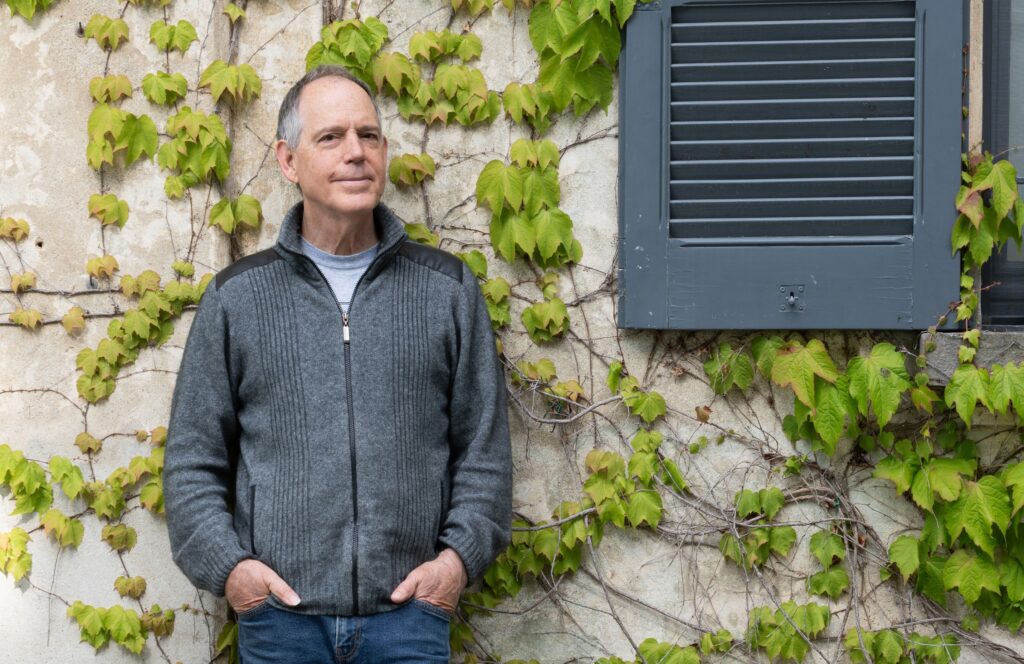
Bruce Springsteen may be “The Boss,” but when the plainspoken David Wilcox is working his side of introspective folk street, he’s in charge.
It’s why he named his latest album The Way I Tell the Story.
“I think the way that I reframe the stuff that I’ve been through so that it isn’t just a victim story, I was always concerned that the habits that we have with our own thought really create the world we live in,” said Wilcox. “And I wanted to give myself a sense of adventure rather than a sense of victimhood.”
A master at spinning yarns and deftly and gently tangling them in lovely acoustic-guitar renderings, the singer-songwriter is coming to Wisconsin this week for a series of shows, starting April 8 with a date at Fish Creek’s White Gull Inn, followed by gigs at Appleton’s Gibson Community Music Hall April 9, the Unitarian Church North in Mequon on April 11 and The Bur Oak in Madison on April 12.
He’s especially looking forward to taking little side trips in the state and being back in Door County, while sharing his newest tunes, with all their bighearted expression and resilient universality.
“There’s a bunch of new songs that I’m really in love with because music has always been my sort of therapy,” said Wilcox. “And so, you know, times get tough, music gets good.”
If that is, indeed, the case, then The Way I Tell the Story makes for a goldmine of authentic, real-deal artistry, forged in times that tested him and his late wife, who fought Parkinson’s. Coming to grips with it has given Wilcox a new perspective, one that’s strengthened his resolve and made him love even deeper – all of which comes through in his latest songwriting efforts.
“It’s hard to really make good music if you’re just feeling good about things,” said Wilcox. “If you’re just having a picnic in the park, there’s not much to sing about. I love how music gives us courage and a sense of community.”
With that ability to relate to others and what trials and tribulations everyone is going through, Wilcox creates lasting connections, as his songs take on new meaning as they age. Concertgoers will, undoubtedly, find something interesting in material old and new when he plays the Badger state.
“There are songs that will be about what we’re all going through, and there’s also the older songs that they’ll love, and I find that they evolve and change even though the words are the same,” said Wilcox. “The song can apply itself differently in different times, and as I grow, so it’s pretty fun.”
Among his newest offerings is a song called “The Beautiful,” which seeks out that which fills the heart with joy, even when things look rather bleak.
“I think that expresses the way a lot of people feel right now,” said Wilcox. “We’ve got to keep our emotional buoyancy. We got to find stuff that will keep us afloat.”
Such observations aren’t simply the product of internal study. They come from interacting with the rest of the world, too.
“Oh yeah, definitely,” said Wilcox. “And that’s a great example of that because the original song is this music and the beauty that I find in the sound of the guitar, and the first verse of the song originally was all about that, but it was a better metaphor when I started talking about the frame around the painting being like the boat that holds back the ocean. And I love how there’s always something in our life that can kind of give us that sense of safety and beauty. That whole song is framed as if you’re walking through an art museum thinking about the courage it takes to decide to make beauty in a world that is full of a lot of distractions and fears.”
In the late 1980s, there was a buzz about this young singer-songwriter, after his debut LP The Nightshift Watchman led to him signing with A&M Records. Then came his initial major label outing in 1989, called How Did You Find Me Here, which sold more than 100,000 copies. His success came the old-fashioned way, through touring and fans spreading the gospel – this at a time when folk music was largely ignored by the music-buying public. Wilcox broke through the noise with sublime guitar playing and soft sincerity.
Rolling Stone said he had “soulful insight,” while the New York Times described his work as “a kind of open-hearted therapy.” Wilcox’s playing style, influenced by the great John Martyn, has long been revered.
“I loved the playing of John Martin, a great guitar player,” said Wilcox. “And he played in a lot of open tunings. And my first inspiration was Joni Mitchell. I learned a lot of Joni Mitchell stuff. And I would just figure out all the open tunings. And I really loved the fresh start that changing the tuning of the guitar gives you when all the chord patterns are different. And it gives me that beginner’s mind again.”
Joining A&M opened doors for Wilcox, but he admits to having tunnel vision at the time.
“The fascinating part is it’s really impressive to me now, but back then … I was just working,” said Wilcox. “I was busy. It’s interesting that a lot of the most famous places that I’ve been and the coolest studios and everything, you know, people find out I recorded at such and such a studio in New York, and they’ll say, ‘Oh my God, what was that like?’ And, you know, at the time I didn’t notice it. I was just working.”
Others were certainly taking notice of Wilcox, as he went on to share stages with the likes of Shawn Colvin, John Gorka and Patty Larkin, while critical praise was heaped upon Wilcox records, such as 1994’s Big Horizons, 1997’s Turning Point and 1990’s What You Whispered.
Flash forward to 2018, when Wilcox was recognized in the 23rd USA Songwriting for the song “We Make the Way by Walking,” off The View from the Edge, and that “emotional buoyancy” he talked about was coming through loud and clear.
What Wilcox didn’t realize when he was riding high was that the music industry was changing, and not for the good.
“Now, I look back on it, and I think, ‘Oh my God, I wish I had known because that was a real golden age for music, and it was sort of the final hours of the whole music industry,” said Wilcox. “Because by the time my second, third records on A&M came out, they had already been sold to Seagram’s. Because the radio stations and the business, it just became more kind of controlled and less creative, but I got in on a real a moment when radio programmers sort of didn’t know what to play. They didn’t know what was next and those times of change and shift are always … they had more freedom. Because most of the way the music industry used to operate was sort of like when you watch a regular soccer game, everyone’s playing in their position, spread out across the field ready for what might happen next. But when you watch little kids play soccer, like peewee soccer, there’s just this clump of kids around the ball. Nobody’s in position. And so, the music industry was sort of like that. Everyone was just doing what everyone else was doing.”
Back then, he said, nobody had a crystal ball, and he added, “That was a beautiful time to be in the industry.”
For Wilcox, making How Did You Find Me Here was especially magical.
“Well, I got to record that in what turned out to be another really classic studio,” related Wilcox. “But at the time, of course, it just seemed to me like a funky little attic in a funky old house. But it was a real classic Nashville studio, and I was working with an Irish producer that had worked with all kinds of really interesting bands. And we just had a fantastic time. It felt like it was lucky and sort of blessed. It was fast and kind of easy.”
Wilcox also got to meet someone memorable.
“You know, the guy who owned the studio, Cowboy Jack, a famous character in the history of music, he came upstairs, and he leaned against the doorway for a little bit, and he was watching the bass player do an overdub,” Wilcox recalled. “And he tried once and twice and three times, and as Cowboy Jack got bored watching this, he called out, ‘Boys, you know how long it takes to record a hit record? Three minutes.’ And he turned around and walked away. So, he was holding the whole history of when there weren’t multi-track recorders. He was like, ‘Get it right the first time, boys.’”
That philosophy has always resonated with Wilcox. It’s a little like working without a net or leaping from a plane without a parachute. The song “Endless Summer Blue,” from The Way I Tell the Story, is all about taking a leap of faith.
“It’s a simple love song. It does have a little bit of a sense of humor because it’s about proposing marriage while skydiving, but it’s also about the beautiful view and the exhilaration of falling in love and capturing that memory so indelibly because of the nervousness and the excitement,” said Wilcox. “And yet the third verse of that song is … talking about when the winter comes and the sky is cold and gray we’ll keep that ‘endless summer blue. And I will be in love with you.’ To me, that song means so much more because it covers that whole time with my lovely wife, Nance. She passed away about three months ago. And the way that song captures the whole span of our time together, it’s a very sweet song for me to sing.”
Going out on the road will be therapeutic for Wilcox, who plans on playing a mix of older and newer material. He’s known, however, for not necessarily sticking to the set list.
“I will be playing a nice balance of all the different kinds of feelings and moods, but I also love to sense where the crowd is and what they’re feeling and where they need to get to emotionally,” said Wilcox. “So, I’ll be sort of adjusting my set to what they need.”
As for all the aspects of touring that may not always be enjoyable for some, Wilcox is relishing every bit of it.
“It’s more fun than ever. That’s the weird part,” said Wilcox. “I think what I’ve done is I’ve come at my whole career … [is] I have nurtured the soil of my music. I have made it so that I love music more than ever now, and it seems like when I tour, I love every part of it. I love the driving and the flying, and I love setting up the sound. It seems like everything is filled with purpose because I respect how music can really matter, and so, it gives everything else meaning.”